
Advisory service
OPERATIONAL PROCEDURE IMPORT CUSTOMS CLEARANCE
1. Customs procedures
This document is issued for the definitive entry of goods into Côte d'Ivoire. Duties and taxes are payable on
presentation of an IM4 to customs. There are 2 possible applications:
➢ Exemption from duties and taxes for goods imported under a letter of total or partial exemption. partielle
➢ Full duties and taxes for unpaid goods.
The documentary procedure is as follows:
▪ Receipt and analysis of import documents
▪ Submission and validation of the Import Declaration Form (FDI)
▪ FDI sent to importer for issue of COC/VOC Confirmation Certificate (established at origin) by the structures approved by the State of CI.
▪ Receipt of COC and transport document depending on terminal
▪ Submission and validation of the RFCV
▪ Control edition (CE)
The temporary import of goods into Côte d'Ivoire is authorised, provided that a request is made to the
Director General of Customs. Temporary admission may be granted in various cases: diplomats, organisations, etc.
raw materials for processing, equipment for repairs, equipment for major projects such as
road construction machinery. Goods that have been temporarily imported by an IM5 can be
be re-exported under an EX3 regime or released for consumption under IM4.
Temporary admission is valid for 12 months, renewable twice.
The applicable taxes are the TS Douane (20,040 FCFA) and the RSTA (1% of the CIF value).
The IM6 (D53) is issued to allow temporarily exported goods to re-enter the country.
The D53 is the declaration that clears the D56, which allowed the goods to be temporarily exported for repair.
or modification.
The documents required are :
▪ The D56 declaration
▪ The commercial invoice
▪ Return reserve submission
Duties and taxes are only payable on the value of the freight plus any spare parts that have been changed or repaired,
or improvements that have been made.
This scheme allows goods to enter the country without payment of duties and taxes. These products are considered
as out of the country and cannot be used by the importer. The goods are stored in the importer's warehouse under customs supervision, and are then cleared through customs. The importer must have authorisation from
Director General of Customs, who will monitor the entry and exit of goods.
Maximum residence time for goods in bonded warehouses :
▪ 18 months for fictitious warehouses. It is the responsibility of an importer or authorised customs agent to
▪ 2 years for special warehouses. It is intended for goods requiring precautions or special handling.
It is owned by an importer.
▪ 3 years for real warehouses. Granted to a local authority or public body.
It generally concerns raw materials and high-value goods such as vehicles.
The applicable taxes are the TS Douane (20,040 FCFA) and the RSTA (1% of the CIF value).
This document is issued for goods in transit from one customs office of entry to another, where they are
will be cleared under IM4, IM5 or IM7. Transit is said to be internal when goods are moved from one point to another.
from one customs territory to another. It is said to be international when it takes place between countries.
The time required to complete the transit operation (transit time) and the route to be taken to convey the goods
are determined by the office of departure and carried out under escort by the customs authorities. The operation is covered by a
caution.
Goods may remain in transit for a maximum of one month.
2. Documents required for customs clearance / release for consumption
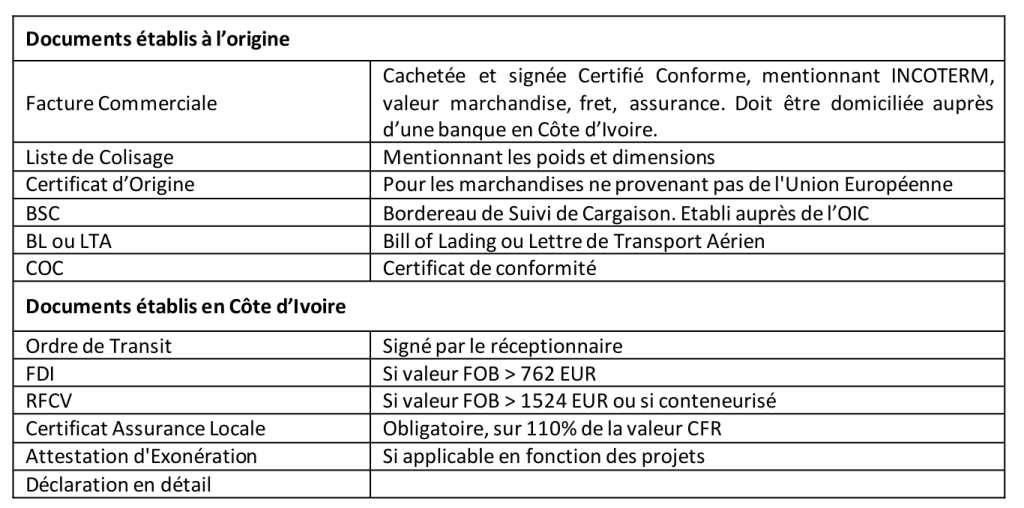
A number of documents are required to declare goods for import.
Documents must be produced depending on the nature, destination, value and origin of the goods.
goods. Some are required at the admissibility stage, others at the declaration verification stage.
The list below covers the most frequent cases (general merchandise, construction materials, goods, etc.).
and industrial equipment...). Specific documents may also be required for certain types of goods at
Imports (personal effects, foodstuffs, pharmaceutical products, live animals, remains, works of art, works of craftsmanship, etc.)
antiques, second-hand vehicles, arms and ammunition, explosives, currency, stones and metals.
second-hand goods, denatured ethyl alcohol)
All importers must be legally registered in Côte d'Ivoire, and in particular have the following documents:
- Taxpayer account
- Importer / exporter code
- Trade register
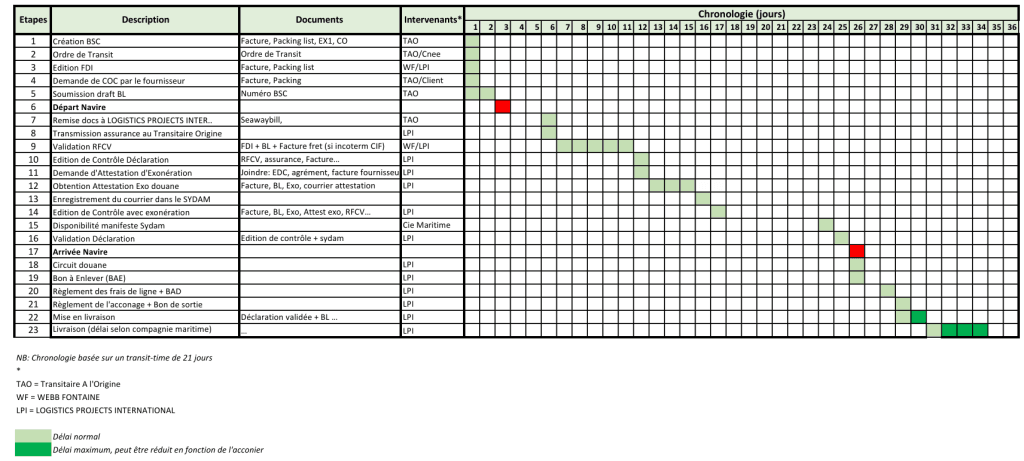
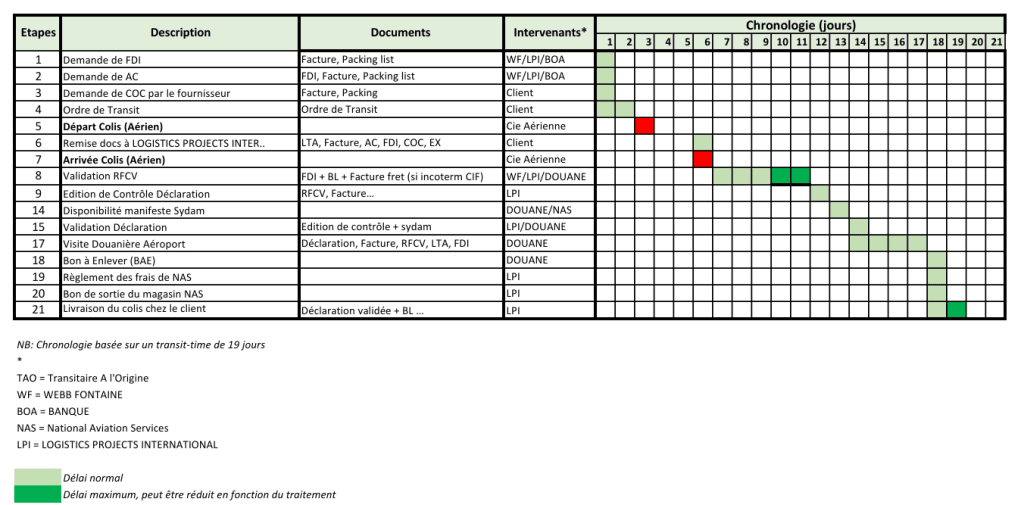
3. Import chronology
- Maritime
- Aerial
Customized logistics, our expertise